
In the Thick of It
The support you need when you need it.
The road through divorce is complicated, but we believe that by breaking it up into manageable tasks you can get through it. Onward provides timely tasks and prompts to help you complete and organize all the legal, financial, and family pieces you need to complete the filing process, all while keeping a close watch on your emotional health as well.

Onward provides:
- Personalized Task Management
- Legal & Financial Support
- Secure Document Storage
- Comprehensive Resource Center
- Onward Experts & AI-powered Assistance
- Access to Support Groups & Community
In the Thick of It Topics
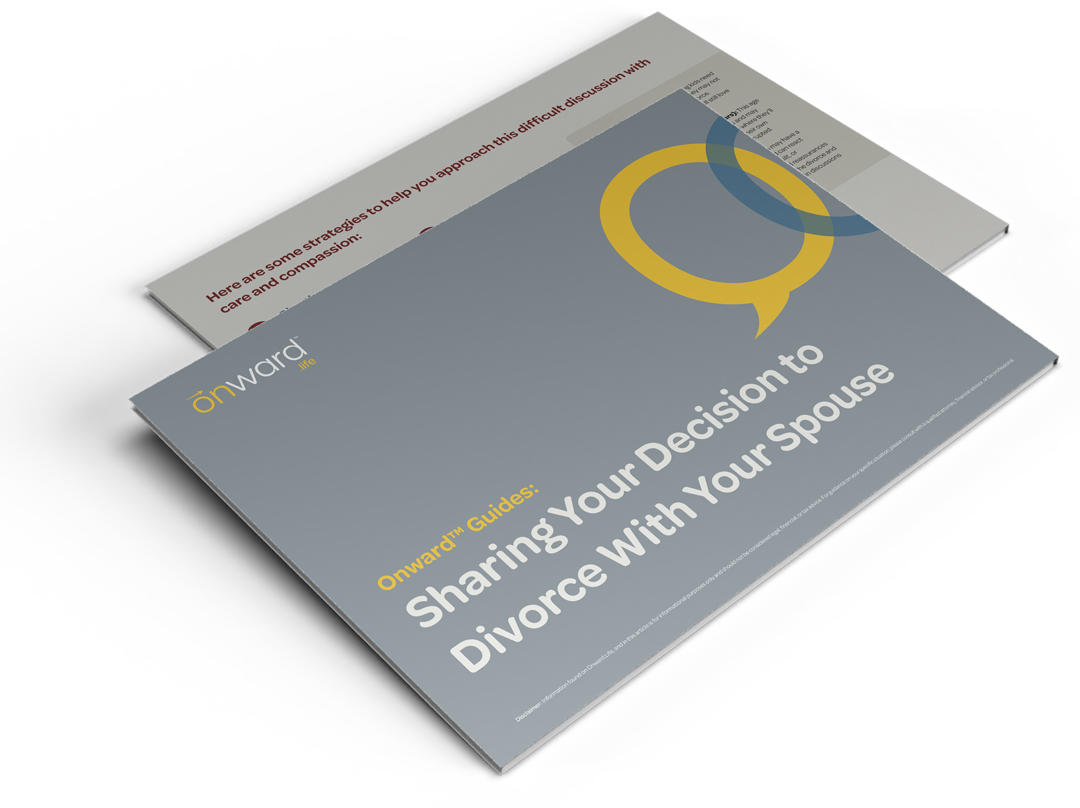



Pricing & Features
Most Popular
Essential
Everything you’ll likely need to guide you
- Personalized assistance through entire divorce journey.
- Tools to streamline financial disclosure requirements
- Expert advice from Onward Specialists
- Secure document storage
- Full access to Onward content library
- Community forums
- Emotional wellness guidance
Free
Premium
Everything in Essential, plus add'l tools for more complex cases
- Assistance with completion & filing of required state forms
- Parsing of uploaded financial statements and forms
- Budgeting Tools
- Settlement Simulation
- Co-Parenting Calendar
- Expense reimbursement submission and tracking
$150
/ month
Collaboration
Everything in Premium for you and your spouse, lawyer, or financial advisor

$250
/ month
Post Divorce
- Custom, detailed instructions for all divorce settlement obligations
- Personalized plan for establishing independence
- Expert advice from Onward specialists
- Secure document storage
- Full access to Onward content library
- Emotional wellness guidance
- Community forums
$20
/ month
Frequently Asked Questions
How long does the divorce process take?
The timeline varies significantly based on several factors. Uncontested divorces where both parties agree on all terms take a minimum of 2-6 months in most states. Contested divorces involving disagreements on property, custody, or support can take 1-3 years or more. The specific timeline depends on your state’s required waiting periods, court backlog and scheduling, complexity of assets and custody issues, and level of cooperation between parties. Some states require mandatory waiting periods between filing and finalization.
What is the difference between contested and uncontested divorce?
An uncontested divorce occurs when both spouses agree on all major issues including property division, child custody and support, and spousal support. These divorces are typically faster, less expensive, and less stressful. A contested divorce means spouses disagree on one or more significant issues that require court intervention or extensive negotiation. Even if you start with a contested divorce, many cases settle before trial through negotiation or mediation.
What is divorce mediation and should I consider it?
Divorce mediation involves a neutral third-party mediator who helps couples negotiate and reach agreements on divorce terms. Mediation is typically less expensive than litigation, faster than court proceedings, less adversarial and stressful, and gives you more control over outcomes. Mediation works well when both parties can communicate respectfully, are willing to compromise, want to minimize costs, and need a structured environment for discussion. It may not be appropriate in cases involving domestic violence, significant power imbalances, or complete unwillingness to negotiate.
How is property divided in divorce?
Property division depends on whether you live in a community property state or an equitable distribution state. Community property states (9 states including California, Texas, and Arizona) generally split marital property 50/50. Equitable distribution states (the majority) divide property fairly but not necessarily equally, considering factors like length of marriage, each spouse’s income and earning potential, contributions to the marriage, and future needs. Marital property typically includes assets acquired during the marriage, while separate property includes assets owned before marriage or received as gifts or inheritance—though this can become complicated if assets are commingled.
What factors determine child custody arrangements?
Courts determine custody based on the best interests of the child, considering factors including each parent’s ability to provide for the child’s basic needs, the existing relationship and bond between parent and child, each parent’s physical and mental health, stability of each home environment, the child’s preference (if age-appropriate, typically 12+), each parent’s willingness to support the child’s relationship with the other parent, history of domestic violence or substance abuse, and work schedules and caregiving history. Courts generally favor arrangements that maintain both parents’ involvement unless there are safety concerns.
How is child support calculated?
Child support calculations vary by state but typically consider these key factors:
Income Considerations:
- Both parents’ gross income from all sources
- Each parent’s earning capacity and potential income
- Existing financial obligations and other dependents
Custody & Care Factors:
- The custody arrangement and timesharing percentage
- Number of children requiring support
- Child-related expenses (healthcare, childcare, education)
Additional Expenses:
- Medical and dental insurance costs
- Extraordinary medical expenses
- Educational costs and extracurricular activities
- Childcare expenses related to work or education
Most states use guideline formulas to calculate support, though judges may deviate based on special circumstances. Child support typically covers basic needs like food, shelter, and clothing, while additional expenses may be shared separately through the parenting agreement.
What is spousal support or alimony and will I have to pay it?
Spousal support (alimony) is financial support one spouse pays to the other after divorce. Not all divorces involve alimony. Courts consider factors including length of marriage, each spouse’s income and earning capacity, standard of living during marriage, age and health of each spouse, contributions to the other’s career or education, and ability to become self-supporting. Types include temporary support (during divorce proceedings), rehabilitative support (for a set time while recipient gains job skills), and permanent support (rare, typically in long marriages where recipient cannot become self-supporting).
Can I change my name back during divorce?
Yes, in most states you can request to restore your maiden name or previous name as part of your divorce decree. This is typically a simple checkbox on divorce forms and doesn’t require a separate legal name change process. After the divorce is finalized, you’ll use your divorce decree to update your name with Social Security, DMV, banks, and other institutions. You can also choose to keep your married name if you prefer; there’s no requirement to change it back.